Thursday, May 10, 2018

Not Too Late to Advocate for the ERA


“Equality of rights under the law shall not be denied or abridged by the United States or any state on account of sex.” For reasons beyond my understanding, the state of Illinois has never been able to ratify these 24 simple words. If Illinois does ratify the ERA, it will be 35 years late.


This Monday, saying “Better late than Never” and hoping that Illinois would finally get it right, I got on the El Monday, May 7th to attend the Hearing of the human rights committee of the Illinois House on SJRCA4.

The Illinois Senate had passed SJRCA4, the bill that would have Illinois ratify the federal ERA. An ERA for the state of Illinois has been part of the state constitution since 1970. The bill is now before the House. I needed to witness the state of Illinois making history at long last. After all, Abigail Adams had beseeched her husband John Adams to “remember the ladies” in a letter to him on March 31, 1776. They didn’t listen to her and women have been omitted from the Constitution ever since. It was about time.

What I witnessed, however, was probably not Illinois making history but rather reliving it. The room of viewers was packed predominantly with proponents of the ERA. Four panels of witnesses – twenty altogether – had the opportunity to tell the members of the House human rights committee what their opinions were regarding the ERA and about their life experiences that pointed to its necessity. Sixteen people testified in favor and four testified against it.


The arguments were the same as they had been in the 1970’s. Rep. Lou Lang, chief sponsor of the bill, started off presenting cogent arguments. The state and federal government needed to ratify the ERA to protect women’s rights. At present, the only right for women delineated in the Constitution is the right to vote. Laws passed which give equal rights to both sexes can be repealed at any time. The opposition gave the same old arguments: that the ERA would lead to more abortions, unisex bathrooms, and a groundswell of boys demanding to play on girls’ high school LaCrosse teams. The ERA states nothing about any of those issues.

After each panel, the House members were able to ask the panelists questions. One house member Mary Flowers asked the same questions to each panel member after a tirade about how the ERA would not specifically protect women of color. Each panel member explained how it would protect all American women but wouldn’t explicitly protect women of color from racist discrimination. The bill is about sex, not race. The vociferousness with which Ms. Flowers presented her arguments suggested to me that some behind the scenes horse trading to which the public was not privy was most likely going on. The failure of the Illinois House to make some bargain was what doomed the ERA to failure in Illinois in the 1970’s.

 I hope that I wasn’t seeing Illinois history repeat itself. At this writing, a hearing in Springfield in the Illinois House is in process. There’s still time to call your representatives and tell them to vote YES. All of us American women – white, black, Asian, Latina, native American, pink, green, or whatever – deserve better. It’s about time.  

Thursday, May 3, 2018

Standing Against Racism in Trump's America


Every spring since 2007, the YWCA has organized a national stand against racism. During the stand - usually from 2:00 to 2:25PM, people in towns throughout the United States stand in unison declaring their opposition to racism. www.standagainstracism.org

This year in our increasingly polarized society, I felt that I had to stand with the YWCA and all groups that were saying that bigotry is wrong. I was proud to stand at my synagogue Beth Emet in Evanston to do this.

While it should be self-evident that racism is wrong, apparently it isn’t. Expressions of racism, anti-Semitism, anti-Muslimism, and attacks on the LGBT community have risen sharply since the presidential election in 2016, spurred in large part by T’s racist rhetoric. In the days immediately following the election, 867 incidents of harassment and intimidation of African-Americans, Jews, Muslims, and people in the LGBT community were reported. The Southern Poverty Law Center (www.splcenter.org) reports an increase in hate groups. They have identified 954 hate groups operating in the United States. The FBI reports anti-Semitic incidents up 55% in 2017, anti-Muslim incidents up 25%, and increased incidents against the LGBT community.

After the disturbances in Charlottesville, I watched in horror as the President of the United States gave a press conference attesting vehemently that many of the people joining the march of neo-Nazis and the Ku Klux Klan were “fine people.” Since then he has reiterated many racist statements thus emboldening racists to act on their feelings. After Charlottesville, for example, the Holocaust Memorial in Boston was vandalized for the second time that summer. Although the perpetrator was arrested and charged with a hate crime, the fact is that it was done.

I am not accusing our current president of creating racism, anti-Semitism, xenophobia, and homophobia. Evidently people always had those feeling but they lay under the surface. In the past, however, people knew that acting on those feelings was unacceptable in the United States. Since 2016, they have been given permission to express those feelings. For myself, any feelings I had of being secure and safe in America have been erased.

It is because of this that it is more important than ever that we stand against racism. We have to stand and say that racism is not acceptable. After the stand, we standers from Beth Emet joined a discussion at the Unitarian Church with members of their congregation as well as people from St. Marks Episcopalian Church. We reaffirmed our opposition to racism and discussed efforts being made in our community to combat it.

Some say that there will always be people with racist feelings and I agree that there will be. I can’t control what is going on in the hearts and minds of other people. I can, however, work with other people to create a situation in which people are not allowed to act on those feelings. That’s the direction the United States had been headed toward during the past few decades since the Civil Rights Movement. We have to work together to get our country to return to that direction. I hope that it’s not too late.


Thursday, April 26, 2018

Home from Prison - A Bleak Picture at the Victory Gardens Theater


There’s something about traveling that every trip has in common. At some point, you have to come home. What happens when you have nothing positive to come home to? What if there is no one to welcome you back? How do you get back in the swing of things?

Living in the Chicago area this is not a problem for us. One great thing about coming back is being able to enjoy Chicago’s phenomenal theater scene. With more than 100 theaters of every variety, we get to pick and choose from a great wealth of plays. This week we saw Lettie at the Victory Gardens Theater. It will be playing through May 6th. If you live in the Chicago area, I strongly recommend that you see it.

Lettie, the title character, has just been released from prison after having been incarcerated for seven years. Sent to a halfway house to live, she starts a welding training program. Uninterested in becoming a welder but going along with the program as well as she can, all she wants is to see her children again. Her sister, who has been taking care of them in Lettie’s absence, has other plans and thus, the drama begins. As the story unfolds, we learn that Lettie has little to return to with few prospects on the horizon. Will she succumb to past influences or stay straight? With community support for ex-prisoners weak at best, staying straight is even more difficult than you’d think. I don’t want to give away the ending in case anyone has the opportunity to see Lettie. It is a very powerful, poignant drama.

Boo Killebrew, the playwright, did an excellent job of depicting the problems that returning prisoners have re-integrating into the outside world especially if their lives prior to imprisonment had no healthy connections or relationships with which to reconnect. The play was skillfully directed by Chay Yew and the acting was excellent. Prior to staging the play, Ms. Killebrew and the cast visited Grace House, a halfway house similar to the one depicted in Lettie, where they visited with women who had pasts similar to Lettie’s. The afternoon they spent there gave them extra insight to skillfully present this play.

With America having five per cent of the world’s population and twenty-five per cent of the world’s prison population, Lettie addresses an important issue. What kind of treatment are we giving to people who are released from prison? How can they avoid returning to prison when it is so difficult finding employment for those with prison records? Where do they live if they have no family to take them in? Most people don’t realize that people with prison records are ineligible for government subsidized housing. Some private agencies are addressing these issues but so much more needs to be done. Go see Lettie at the Victory Garden Theater. It will give you a lot to think about.


Thursday, April 12, 2018

Still Desperately Seeking Manatees


Although I’ve been visiting South Florida nearly all my life, one animal I’ve yet to see there in the wild is the manatee. I’ve see signs along the Intercoastal waters warning boaters to reduce their speed in order to protect them. We’ve visited The Merritt Island National Wildlife Refuge near the Space Center and the Turkey Creek Sanctuary in Palm Bay where they’ve often been sighted, but to no avail.

I’ve often wondered what makes these sea creatures even more elusive than mermaids. They are generally slow-moving, gentle creatures most closely related to the elephant and often called sea cows. They seek warm – no colder than 68 degrees Fahrenheit - brackish water and feed on water plants.

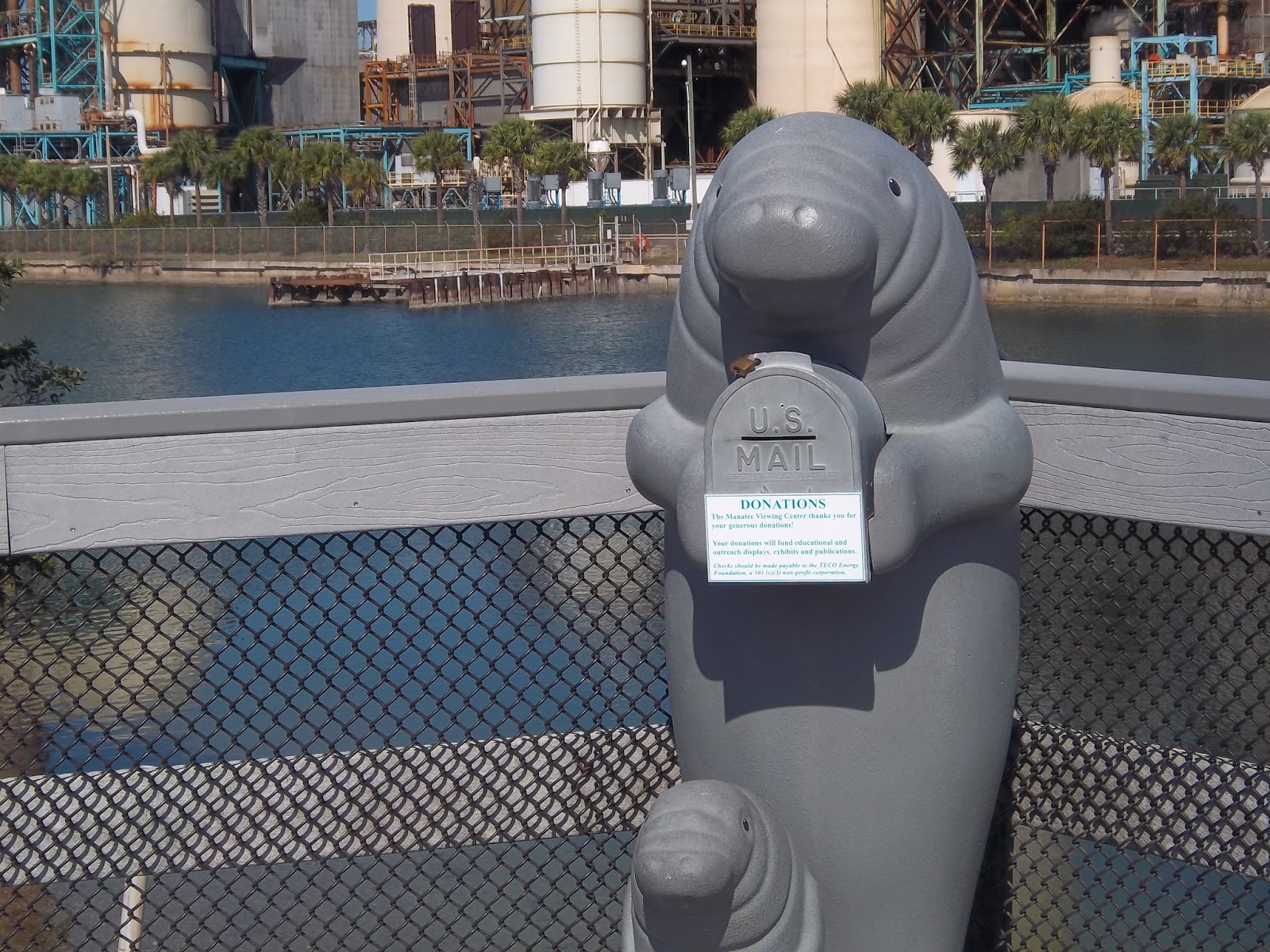
Thus, when we arrived in Tampa, Florida, I was delighted to find out that they have a Manatee Viewing Center run by TECO, Tampa Electric Company. www.tampaelectric.com/manatee. The heat generated by the electric plant heats the water around it to temperatures comfortable for manatees. 
Since these animals tend to migrate to warmer waters, they often congregate near the power plant when the rest of the water around Tampa Bay is too cold for them.


Eager to finally see manatees in a somewhat natural habitat, we headed to the Manatee Viewing Center which was established thirty years ago. They have built several boardwalks and trails out to the viewing areas as well as a nature center and they have videos about these gentle creatures. It is quite an impressive site.

With camera ready, we walked all the trails. I saw a ripple in the water. Could it have been the tail of a manatee? Alas, that was all I was able to see so we’ll never know. Apparently, with the warm winter that Tampa had been having, the manatees had no need to swim all the way to the power plant. As their brochure states, the best time to see them is when the temperature in Tampa Bay is about 68 degrees Fahrenheit. When we were there, the temperature in and around Tampa Bay was about 85.

Nevertheless, the Viewing Area was worth seeing. We were impressed to see the efforts made by TECO to utilize solar power to generate electricity as well as their efforts to protect manatees in Florida. We were able to see various birds and schools of fish near the power plant as well.


When we went to the Turkey Creek Sanctuary and to Merritt Island, Florida had been having a cool winter and the manatees hadn’t come back there yet. In Tampa, we were there when the waters were too hot. Hopefully, someday we’ll return to one of those sites when the water is just right. In the meantime, our next stop is the Cincinnati Zoo. They have manatees there and you’re guaranteed to see them all the time.


Thursday, April 5, 2018

Remembering History in Memphis On the Eve of Dr. King's Assassination

I was in a campaign meeting on the campus of SUNY Binghamton for Gene McCarthy when another student ran into the room with bloodshot eyes and ragged hair. "Martin Luther King was just shot!" he yelled. It was 1968, before the days of 24/7 news cycles. Someone turned on a radio to hear what was happening. After that, our meeting and in fact our lives, were never the same again.

Fifty years have passed and I've often reflected on how that killing changed America. I'm glad that we had the opportunity to visit the Brooks Museum in Memphis,Tennessee www.brooksmuseum.org. because they have an exhibit which lends pictures to those memories. A temporary exhibit, there until August 19th, highlights photographs of events leading up to that tragic day. 

There are two special temporary exhibitions going on at the Brooks Museum now and in a sense, their themes are related highlighting the need for the movement that Dr. King led. Both exhibits will be there through the middle of August, 2018 so there’s time to plan a trip there. We started by touring the exhibition “Black Resistance: Ernest C. Withers and the Civil Rights Movement” This exhibition is a trove of photographs that memorializes the Civil Rights Movement especially in respect to events that took place in Memphis. These were events that affected the course of history throughout the United States and at the risk of showing my age, I have to say that I remember them too well.

The most iconic of the photographs shows the sanitation workers marching with their famous placards I AM A MAN. Dr. King had just before that talked about the confluence of race and poverty and had begun to address issues of economic justice. It was soon after that march that Dr. Martin Luther King, Jr. was shot by James Earl Ray and the rest of our history morphed into the present. Other photographs are of other events that took place during the Civil Rights Movement. It was an emotional moment seeing them especially knowing that we have to advocate for all the rights won at that time all over again in light of our current regime in Washington.
I Am A Man taken at the Sanitation Workers' Strike
On the way to the next exhibit, we saw some paintings and prints by Carrol Cloar. The dignity that he is able to portray in his subjects underlines the yearnings seen in the photographs of Ernest C. Withers. My favorite was this one “Wedding Party” that was painted in 1971.
Wedding Party by Carrol Cloar
After this emotional exhibition, it was good to move on to the next one “African-Print Fashion Now! A Story of Taste, Globalization, and Style.” This exhibition shows the development of fashion, fabrics, and patterns in Africa. Although on the surface, the subject seemed more light hearted, it actually depicts an aspect of the history of colonialism in Africa. It shows how the Europeans exploited their knowledge of African preferences to start the fabric and fashion industry from which they profited.


In a sense, it is a forerunner to the exhibition of photographs from the Civil Rights Movement showing once again how the issues of race and economics are connected. As such, you need to see both of these exhibitions. They’ll be there until August 19th and August 12th   respectively. 


Besides that the Brooks Museum is well worth seeing. 
The Brooks Museum

It is probably one of the more under-rated museums that we had been to. Located within Overton Park, the building itself is something to see. You won't be sorry that you made the trip. 

Thursday, March 29, 2018

Pura Vida - for Animals, Too


We asked our homestay family in Heredia, Costa Rica if it would be worthwhile to visit the zoo in Alajuela, the next nearest city, on Saturday when school was closed. They looked embarrassed and suggested going for a hike in the Bosque de Hojas, a natural site in a mountain town near Heredia, instead. Our Spanish teacher, who had told us about the zoo in the first place, discouraged us from going there. In fact, none of the Ticos [Costa Ricans] seemed to want to talk about the zoo at all, as though it were some kind of national dirty secret.

Curious about why this was, I consulted our Costa Rican guidebook. The zoo in Alajuela is one of only three in the country as the Costa Ricans have become the first country in the world to outlaw zoos. They have kept three zoos open until all the animals in them die. The ones left in the zoos have either lost their instincts to fend for themselves in the wild or are too dangerous to humans to be released. In fact, all the animals in the Alajuela zoo are rescue animals. This sounded interesting in itself but we opted for Bosque de Hojas instead.

In Samara, we stayed at a beautiful little hotel surrounded by trees and tropical plants. A family of monkeys lived on the roof undisturbed. Iguanas lived in the area surrounding the swimming pool. In Tamarindo, our hotel was home to another family of monkeys. Different types of iguanas lived in the bushes surrounding the hotel.

the monkey family living on the roof of our hotel

Throughout Costa Rica, we saw beautiful species of birds some that we had never seen anywhere else. Who needs a zoo?

It was interesting to see that Costa Rica has been leading the way on many issues concerning the environment. Sixty five percent of their energy is from renewable sources – mostly solar. Twenty seven percent of their land is reserved for preservation of natural ecological sites.

One thing I really liked in Costa Rica is that the deer is a national symbol and its picture is on some of their currency. Anyone caught deer hunting is subjected to steep fines. Then again, it would be difficult to deer hunt in Costa Rica because it’s very difficult for any civilians to obtain guns there. As a result, they have the lowest homicide rate in Latin America. Definitely something to think about as we go forward in our national debate on gun control.

One of our last class exercises epitomized the Costa Rican attitude towards animals. We read a Spanish version of Little Red Riding Hood. Most of the story was the same until we got to the end. When the wolf jumps out of Grandma's closet, Grandma jumps out with a pistol. A guard of the woods enters the room and yells, "Don't kill him, Senora! Wolves are an endangered species. Take him to an animal refuge." (rough translation) Red Riding Hood and Grandma learn their lesson about protecting endangered species and the wolf's life is saved.  

As I laughed at that story's ending, I felt an affection for the Costa Ricans. I wondered if a country’s attitude toward animals and its actions toward them is reflective of its attitudes towards its people? What does it say about the kind of society that it is? It's certainly something to think about. I wish you all the good fortune to be able to visit this remarkable country. See Costa Rica and ponder how you would answer these questions.  Pura Vida!


Thursday, March 22, 2018

The Other Side of the Table - Spanish Immersion Classes


After several years tutoring immigrants at the ESL Café, my husband and I got a taste of my own medicine at La Escuela Intercultura www.interculturacostarica.com in Heredia, Costa Rica by taking Spanish immersion classes.

Besides being in class for four hours a day, the school can arrange homestays where students live with a family, eating breakfast and dinner with them. We were thrilled to do the homestay figuring it would be a good opportunity to practice speaking Spanish. For years, I would tell students, “You only speak to me an hour per week. You need to practice more. Watch English speaking TV. Talk to English Speakers. Go on www.mylanguageexchange.com and find a skype partner. The more you practice, the better you’ll get.”

At Intercultura, we had to do just that - in Spanish. Herediais an older colonial era town of about 250,000 people with a large branch of the University of Costa Rica. Since it isn’t a tourist town, the people there don’t practice speaking English very often and seem self-conscious when they do. Almost everyone in the town was very patient with us, conversing with us in our inadequate Spanish.
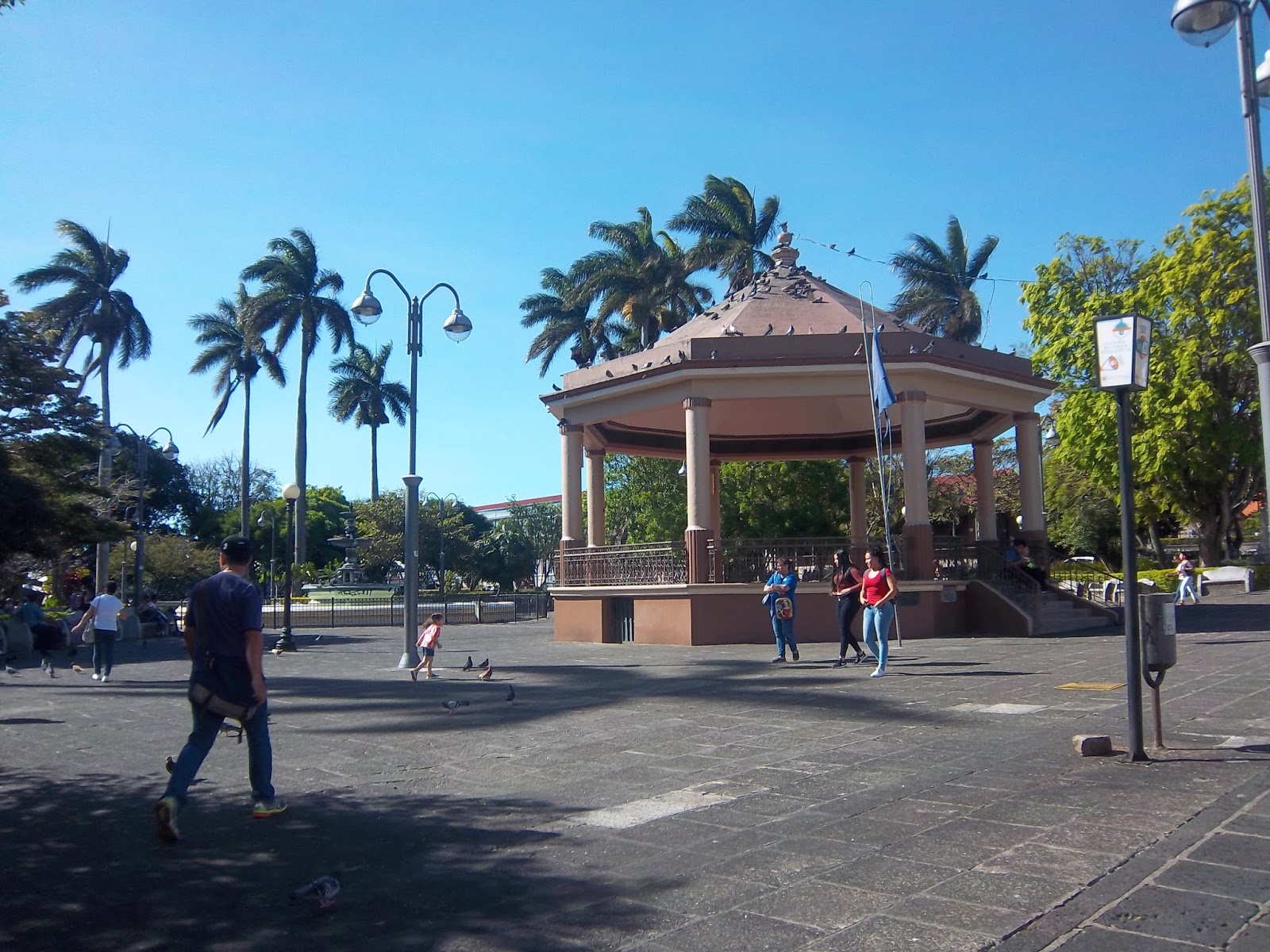
main plaza in Heredia


While there are many language schools for adults in Costa Rica, La Escuela Intercultura is probably one of the best. We were placed in an intermediate Spanish class with four other students. Our Spanish teacher was excellent constantly changing our activity using every learning method so that the lesson would sink into our older brains. The four hours each day flew by.

In addition to Spanish classes, the school has various cultural activities – tours of Heredia, dance classes, Costa Rican cooking classes. Our favorite was the language exchange. Besides providing Spanish classes, Intercultura provides English classes to the locals. Twice a week we had an opportunity to speak with these students - half an hour in English and half an hour in Spanish. Most of the Costa Rican students were university students and we worried about how interested they’d be in talking to older retired Americans. This worry was totally unfounded. They were very cordial and eager to talk to us, interested in talking to us intent upon hearing everything we had to say about our attitudes on a variety of subjects.


The family we stayed with was very encouraging and spoke to us extensively about Costa Rican life. We arrived at their house on their Election Day. On a walk through their town, they took us to their polling place. The whole town was celebrating as they got out to vote. This was such a contrast to elections in the United States that it was a pleasure to witness. The man of the family was very involved in the campaign. We watched the election returns on TV with him as he talked to us about it throughout the evening. Unfortunately, we only understood about 30% of what he said. This was frustrating to me. I would have loved to have a real discussion with him about the issues facing Costa Rica. By the time we left their house, however, we understood about 60%.

Did we become fluent Spanish speakers? Of course not. Who can become fluent in any language in a couple of weeks? Nevertheless, thanks to Intercultura, we speak Spanish much better than we did before. It was a great experience and I recommend it to anyone who would be able to go there.